
Technical Guide
PerkinElmer LAMBDA 950 Technical Specification and Usage Guide
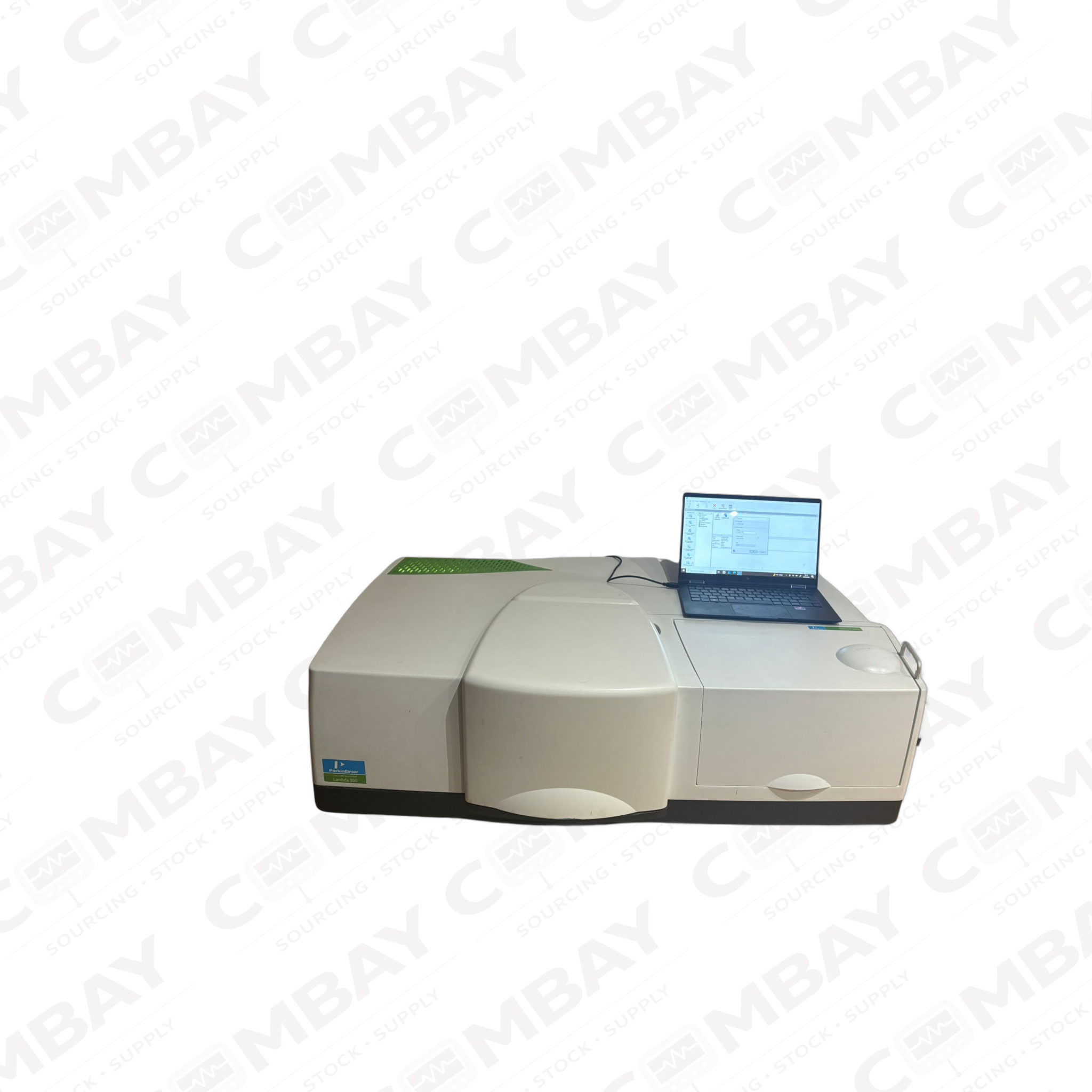
Technical specification and operating guidance for the PerkinElmer LAMBDA 950 UV/Vis/NIR spectrophotometer, including the standard 2D detector module, 150 mm integrating sphere, UV WinLab method setup, calibration checks, troubleshooting and resale support.
Resource type
Technical Guide
Published
14 May 2026
Tags
8 topics
Images
2 assets
Resource gallery
Reference images, instrument photos and related visuals for this guide.

Technical guide
Formatted article view for clearer reading, section navigation and reference use.
PERKINELMER LAMBDA 950
UV/Vis/NIR Spectrophotometer
Technical Specification + Usage Guidance Document
Coverage: LAMBDA 950 main instrument, standard 2D detector module, 150 mm integrating sphere, and relevant 3-detector/3D module notes where they affect identification or method setup.
| Field | Entry |
|---|---|
| Instrument family | PerkinElmer LAMBDA high-performance UV/Vis and UV/Vis/NIR spectrophotometers |
| Primary model covered | LAMBDA 950 |
| Common software | UV WinLab / UV WinLab Explorer, commonly version 6.x on legacy systems |
| Primary accessories covered | Standard 2D detector module; 150 mm Spectralon integrating sphere; notes on 3-detector module if present |
| Primary use cases | Transmission, absorbance, total reflectance, diffuse reflectance, scattering samples, films, glass, optical coatings, powders, turbid liquids, and UV/Vis/NIR material characterisation |
| Prepared date | 14 May 2026 |
| Document status | Operational guidance and technical reference; verify exact part numbers/accessory type on physical labels before use or resale listing |
The LAMBDA 950 is a high-performance double-beam, double-monochromator UV/Vis/NIR spectrophotometer designed for accurate wavelength- and photometry-critical work over the ultraviolet, visible and near-infrared regions. The system is modular: the standard detector module and the second sampling area can be changed or adapted for transmission, reflectance, diffuse scattering, and large-sample optical characterisation. [S1][S2]
For day-to-day use, the most important principle is that the optical geometry used for baseline, autozero, reference and sample measurement must remain controlled. With standard transmission this means the reference/blank and sample beams must be clear and comparable. With an integrating sphere this means all sphere ports, standards, plugs, traps and sample positions must be set correctly before baseline/autozero, and only the intended sample position should change during the run. [S2][S5]
Practical rule If a measurement looks wrong, do not immediately repeat autozero many times. First check the fitted detector/accessory, beam path, port covers, reflectance standard, sample coverage, compartment closure, method detector settings, and warm-up state. Repeated autozero attempts cannot correct a physically wrong optical setup.
2. System overview and configuration map
2.1 Main instrument architecture
| Subsystem | Practical meaning |
|---|---|
| Double-beam ratio recording optics | The instrument alternates sample and reference beam readings. Good data depend on maintaining both optical paths and using the correct baseline/reference procedure. |
| Double monochromator | Improves wavelength purity and low stray light performance, important for high absorbance materials and coatings. |
| Dual light sources | Deuterium lamp covers the UV region; tungsten-halogen covers visible/NIR. The exact changeover is method/instrument controlled. |
| Detector module bay | Accepts the standard 2D detector module and, depending on configuration, optional/upgrade detector modules. Modules must not be fitted or removed while powered. |
| Second sample area / accessory area | Accepts snap-in modules such as 60 mm and 150 mm integrating spheres, universal reflectance accessory, GPOB and specialist optics. |
| UV WinLab control | Instrument setup, method definition, accessory detection, data collection, corrections, sample table and output are controlled through UV WinLab. |
Module naming note: 2D vs 3D In instrument listings and facility pages, “2D detector” normally means a two-detector module: PMT for UV/visible and PbS for NIR. A “3D” or “three detector module” adds an InGaAs detector between the PMT and PbS regions. Some used-equipment listings are imprecise, so confirm by physical label, optical layout, UV WinLab accessory recognition, and fitted detector hardware. [S4][S6]
3. Core LAMBDA 950 technical specification
The following values are compiled from published PerkinElmer hardware guide/specification data for the LAMBDA high-performance series, focusing on the LAMBDA 950 column. [S1]
| Parameter | LAMBDA 950 specification / guidance |
|---|---|
| Principle | Double-beam, double-monochromator, ratio-recording UV/Vis/NIR spectrophotometer controlled by PC. |
| Optical system | All-reflecting SiO2-coated optical system; holographic grating monochromator; UV/Vis grating 1440 lines/mm blazed at 240 nm; NIR grating 360 lines/mm blazed at 1100 nm; Littrow mounting; sample-thickness-compensated detector optics. |
| Beam splitting | Chopper with dark/sample/dark/reference cycle and chopper segment signal correction. |
| Sources | Pre-aligned deuterium and tungsten-halogen lamps. |
| Standard detectors | Photomultiplier R6872 for UV/Vis; Peltier-cooled PbS detector for NIR. |
| Wavelength range | 175-3300 nm. Nitrogen purge is required below 185 nm. |
| Resolution | UV/Vis: <=0.05 nm. NIR: <=0.20 nm. |
| Wavelength accuracy | UV/Vis: +/-0.080 nm. NIR: +/-0.300 nm. |
| Wavelength reproducibility | UV/Vis deuterium lamp lines: <=0.020 nm. NIR: <=0.080 nm. Standard deviation of 10 UV/Vis measurements: <=0.005 nm; 10 NIR measurements: <=0.020 nm. |
| Stray light / stray radiation | Representative specification values include >2 A at 200 nm using KCl USP/DAP method; <=0.00007 %T at 220, 340 and 370 nm; <=0.00040 %T at 1420 nm; <=0.00050 %T at 2365 nm. |
| Photometric accuracy | Representative values: double aperture 1 A +/-0.0006 A; double aperture 0.5 A +/-0.0003 A; NIST 930D filters at 1 A +/-0.0030 A and 0.5 A +/-0.0020 A; potassium dichromate USP/DAP +/-0.0100 A. |
| Photometric linearity | UV/Vis at 546.1 nm, 2 nm slit, 1 s integration: 1.0 A +/-0.0060 A; 2.0 A +/-0.0170 A; 3.0 A +/-0.0200 A. |
| Photometric reproducibility | Standard deviation, 10 measurements at 546.1 nm, 2 nm slit, 1 s: <=0.00016 A at 1 A; <=0.00008 A at 0.5 A; <=0.00008 A at 0.3 A. |
| Photometric range | UV/Vis: 8 A. NIR: 6 A. |
| Bandpass/slit range | UV/Vis: 0.05-5.00 nm in 0.01 nm increments. NIR: 0.20-20.00 nm in 0.04 nm increments. Fixed resolution, constant energy, or slit programming. |
| Baseline flatness | +/-0.0008 A over 190-3100 nm under specified conditions. |
| Photometric stability | <=0.0002 A/h after warm-up at 500 nm, 0 A, 2 nm slit, 2 s integration, peak-to-peak. |
| Sample compartment internal size | Approx. 200 mm W x 300 mm D x 220 mm H. |
| Instrument dimensions | Approx. 1020 mm W x 740 mm D x 300 mm H. |
| Weight | Approx. 77 kg. Four-person lift is recommended for moving; avoid twisting the chassis. |
| Digital I/O | RS-232C interface on legacy systems. |
| Light beam geometry | Beam approx. 90 mm above base plate; 120 mm beam separation; 3-12 mm beam height. |
| Power | 90-250 VAC, 50/60 Hz, 250 VA. |
| Operating temperature | 10-35 deg C. |
| Recommended humidity | 10-70% relative humidity, non-condensing. |
4. Standard 2D detector module guidance
The standard LAMBDA 950 detector configuration is normally a two-detector arrangement: a PMT for UV/visible wavelengths and a Peltier-cooled PbS detector for NIR. Facility and catalogue references also describe a LAMBDA 950/1050 “2D” configuration as PMT + PbS. [S1][S6]
| Detector | Typical role | Practical cautions |
|---|---|---|
| PMT / photomultiplier | UV and visible-region detection. The PerkinElmer specification identifies an R6872 PMT for the LAMBDA 950 UV/Vis range. | Do not operate with covers removed. PMT circuits can involve high voltage. Saturation or low signal may be caused by wrong slit, wrong attenuator, wrong beam path or lamp issue. |
| Peltier-cooled PbS | Near-infrared detection across the NIR region for the standard LAMBDA 950 detector module. | Requires stable thermal/electrical behaviour. NIR noise is sensitive to slit width, response time, lamp energy, detector gain/mode, purge/water vapour effects and accessory alignment. |
| Optional InGaAs in 3D module | Not part of a standard 2D module. If present, this is a three-detector/3D configuration with PMT + InGaAs + PbS. | UV WinLab v6 instructions for the three-detector module show detector change points and accessory recognition; older UV WinLab versions may recognise the module but expose only PMT and PbS. [S4] |
Identification checklist for your physical 2D module Record: label text; serial number; connector condition; whether the module says “STD 2D”, “2D Detector”, “Three Detector Module”, “InGaAs”, “PbS” or similar; whether UV WinLab recognises it as a standard detector or three-detector accessory; and whether the hardware drawing shows two detectors or a mirror-translation unit for three detectors.
5. 150 mm integrating sphere technical and usage guidance
The 150 mm integrating sphere is the key accessory for scattering samples, diffuse transmittance, diffuse reflectance, total reflectance and colour/material measurements where a normal detector would miss deflected or scattered light. PerkinElmer’s accessory brochure describes the sphere as a research-grade accessory for diffuse reflectance, relative specular reflectance and diffuse transmittance of solids and liquids; it also highlights the smaller port fraction and baffle design used to reduce first-strike errors. [S2][S3]
| Feature | 150 mm integrating sphere guidance |
|---|---|
| Primary purpose | Collects scattered, diverging, converging or beam-deflected light that may otherwise miss the detector, avoiding artificially low transmittance or reflectance readings. |
| Common geometries | Double-beam active reference mode; specular-included 8 degrees/hemispherical or specular-excluded geometry, depending on port plug/trap configuration. |
| Sphere surface | Typically Spectralon-coated in the 150 mm sphere family; keep clean, covered and protected from powders/liquids/fingerprints. |
| Standard 150 mm sphere detector variants | PbS 150 mm sphere and InGaAs 150 mm sphere variants exist. L6020204 is described as PbS; L6020322 is described as InGaAs in the accessory brochure. |
| Wavelength range stated for 150 mm sphere accessories | Reflectance: 200-2500 nm. Transmittance: 190-2500 nm. |
| Absorbance range stated for sphere variants | PMT: approx. 0-5 A; temperature-stabilised PbS: approx. 0-3 A; 3-stage Peltier-cooled InGaAs: approx. 0-5 A. |
| Sample capacity | Reflectance: effectively unlimited external sample size if port coverage/support is correct. Transmittance: stated sample size up to approx. 20 cm high x 20 cm wide x 14 cm thick for the standard arrangement. |
| Reference materials | Often supplied/used with reflectance standards. Use the correct reflectance standard at the correct port for baseline/autozero. Do not touch the standard surface. |
| Critical mistake to avoid | Changing port plugs, light traps, reflectance standard or sample geometry after autozero invalidates the baseline because the sphere throughput and wall reflectance conditions have changed. |
5.1 Selecting total vs diffuse reflectance
Total reflectance includes specular and diffuse components. Diffuse reflectance/specular-excluded geometry removes the specular component through the exclusion port/light trap. For materials with glossy, mirror-like or mixed scattering behaviour, record whether the result is total reflectance, diffuse reflectance, or specular-included/excluded. Do not mix these terms in reports or sales demonstrations.
5.2 Integrating sphere versus standard 2D detector
| Task | Preferred setup | Reason |
|---|---|---|
| Clear liquid absorbance in a cuvette | Standard 2D detector module with correct cuvette holder | Direct beam absorbance is normally adequate and simpler. |
| Flat optical filter, non-scattering glass | Standard transmission or sphere, depending on whether total transmittance including scatter is needed | Standard module measures straight-through beam; sphere captures scattered/deflected light. |
| Hazy film, frosted glass, textile, paper, powder, turbid liquid | 150 mm integrating sphere | Scattering would cause under-reading with a normal detector. |
| Total reflectance of coating/material | 150 mm integrating sphere with correct standard and specular-included configuration | Captures hemispherical reflected light. |
| Diffuse reflectance excluding gloss/specular component | 150 mm integrating sphere with specular-exclusion port open/trapped | Removes mirror-like component so diffuse component can be reported. |
| Angle-resolved absolute specular reflectance | Universal Reflectance Accessory or ARTA-type accessory rather than ordinary sphere | Sphere is not a substitute for controlled angle-resolved reflectometry. |
6. Installation site, environment, power and connectivity
| Requirement | Guidance |
|---|---|
| Bench | Use a rigid, level bench able to support at least 77 kg plus accessories, PC and clearance. Avoid vibration, flexing, direct sunlight and heavy footfall. |
| Clearance | Allow enough top and side clearance to open sample/accessory compartments and exchange detector modules without twisting cables or covers. |
| Power | Use clean mains power within 90-250 VAC, 50/60 Hz. Avoid sharing with heavy motors, compressors, welders or equipment that causes voltage dips/spikes. |
| Environment | Maintain approx. 10-35 deg C and 10-70% RH non-condensing. Avoid condensation after moving from cold storage; allow the instrument to acclimatise before powering. |
| Purge | Nitrogen purge is required for measurements below 185 nm and is useful when water vapour or atmospheric absorption compromises deep-UV/NIR stability. |
| Communications | Legacy systems commonly use RS-232C. Correct COM port, cable type, serial adapter driver, and UV WinLab instrument configuration are essential. |
| PC/software | Keep the acquisition PC stable. Avoid unnecessary OS updates on legacy UV WinLab systems unless validated. Back up methods, data and instrument configuration files. |
| Accessories | Store detector modules, sphere plugs, standards, sample holders and small accessories in labelled protective containers. Missing plugs/standards can make the instrument look faulty when the issue is only configuration. |
7. Safety, handling and contamination control
Switch the spectrometer off and disconnect line power before changing detector modules or opening module compartments. Do not hot-swap detector modules. [S4][S5]
Treat PMT and detector electronics as high-voltage/sensitive assemblies. There are no routine user-adjustable parts inside detector modules. [S4]
Do not place loose powders, wet samples or volatile liquids directly against the sphere port unless the correct holder, cell or containment is fitted.
Never touch Spectralon surfaces, reflectance standards, mirrors, lenses or detector windows with fingers or cloth. Use clean holders and protective caps.
Do not force module seating. If positioning pins, connectors or thumbscrews do not line up, remove and inspect rather than tightening harder.
Keep compartments closed during measurement. Ambient light leakage can corrupt scans and make autozero/calibration fail.
For unknown used instruments, inspect for smoke smell, melted connectors, loose screws, missing port covers, broken hinges, lamp-hour issues, and evidence of liquid/powder contamination before powering.
8. Start-up, warm-up and shutdown procedure
8.1 Pre-power checks
Confirm the correct detector module/accessory is installed for the intended method: standard 2D detector for normal transmission/absorbance, integrating sphere detector/accessory for sphere measurements.
Open the sample/accessory area and verify both sample and reference beam paths are free of samples, tools, port covers or packaging material unless specifically required by the method.
For the integrating sphere, verify reflectance standard/port plug/specular exclusion port/transmission port positions match the intended baseline condition.
Check PC, RS-232/USB-serial connection, mains cable, and any accessory cables. Do not allow cables to foul module seating or compartment covers.
Close covers before instrument initialization unless the official procedure says otherwise.
8.2 Power-up and warm-up
Switch on the instrument power. Allow it to initialise fully before starting UV WinLab.
Allow at least 20-30 minutes warm-up before serious measurements. A facility SOP for LAMBDA 950 integrating sphere mode also uses a 20-30 minute wait after switching on the system/lamp. [S5]
Start the PC and launch UV WinLab Explorer. Select or create the correct instrument/method. Confirm the instrument appears available.
If the instrument beeps repeatedly, loops calibration, or fails readiness, stop and check beam obstruction, accessory seating, detector module installation, compartment closure, software method mismatch and COM connection before repeating.
8.3 Shutdown
Save/export data and method changes.
Close UV WinLab method windows cleanly. Confirm no acquisition is running.
Switch off the instrument using the normal power switch.
Switch off PC/monitor if no further use is planned.
Cover ports and store reflectance standards/accessory pieces in their labelled cases. Leave the work area clean.
9. Detector and accessory exchange procedure
Do not hot-swap modules The three-detector module guide states that detector modules must only be installed or removed when the instrument is switched off; failure can permanently damage the instrument. Use the same conservative rule for the standard 2D module and sphere detector module. [S4]
Switch the spectrometer off and disconnect line power.
Open the sample/current detector module compartment cover.
Undo the retaining screws or thumbscrews as applicable; do not lose blanking caps or screws.
Lift the current detector/module vertically using the provided handles. Do not lift using removable covers, port plugs or optical fittings.
Inspect the replacement module: connector pins, locating holes, base plate, optical windows/ports, thumbscrews and label.
Lower the replacement module onto locating pins without force, then secure with thumbscrews/front-rear retaining points as designed.
Reconnect line power. Open the sample compartment and verify the beam path is clear.
Close covers, power on, allow initialization/warm-up, and only then launch UV WinLab.
In UV WinLab, confirm the correct accessory is detected/selected on the method accessory page where applicable.
10. UV WinLab method setup guidance
| Method area | Recommended guidance |
|---|---|
| Instrument selection | Choose the correct high-performance UV/Vis/NIR instrument and LAMBDA 950 configuration. Do not reuse a method created for a different accessory without checking all pages. |
| Measurement mode / ordinate | Use A for absorbance, %T for transmittance, %R for reflectance. Energy modes E1/E2 are mainly diagnostic or advanced method modes. |
| Wavelength range | Enter high-to-low range if required by the software/method convention. Keep within the fitted accessory range; 150 mm sphere specs typically stop at 2500 nm for reflectance/transmittance. |
| Slits/bandpass | Use fixed or programmed slits appropriate to energy and resolution. Narrower slits increase resolution but reduce light throughput and may increase noise. |
| Detector settings | Standard 2D: PMT/PbS detector changeover around the instrument default. 3D module: UV WinLab v6 allows PMT-InGaAs and InGaAs-PbS changeover points; earlier software may expose only PMT and PbS. [S4] |
| Attenuators | Use automatic or appropriate beam attenuators for high-absorbance samples. For 3D module guidance, UV WinLab v6 Lambda 950 options include 0%, 1%, 10%, 100%, Automatic and Sample Table. [S4] |
| Corrections | Use baseline/autozero with the exact reference geometry required for the measurement. Corrections expire and should be managed per method and QA requirements. |
| Sample table | Name each sample clearly. Include geometry in the sample ID, e.g. “film_total_R_spec_included” or “glass_T_sphere”. |
| Output | Export raw and processed spectra where possible. ASC/text export is useful for later diagnostics and comparison. |
Lamp/detector changeovers Do not manually change lamp/detector change points unless you understand the optical consequences and have a reason. A site SOP for a LAMBDA 950 sphere setup shows D2/tungsten and detector changeover regions as part of its local method guidance; these are useful diagnostic references but are not a substitute for your fitted module’s official method settings. [S5]
11. Measurement workflows
11.1 Standard transmission / absorbance using the 2D detector module
Fit the standard 2D detector module and the correct sample holder/cuvette holder.
Warm up the instrument and open the intended UV WinLab method.
Set ordinate: A for absorbance or %T for transmittance.
Set wavelength range, interval, slit/bandpass, response time and scan speed suitable for the sample.
Place blank/reference in the reference beam if the method requires it; otherwise keep both beams clear for 100%T/0A correction as specified.
Run baseline/autozero/correction with no sample in the sample beam or with the blank condition required by the method.
Insert sample without moving the reference or changing holders. Confirm sample fully intercepts the beam and is not tilted unless required.
Start scan and wait for the software prompt before removing/replacing samples.
Save/export spectra and record method parameters.
11.2 Total transmittance using the 150 mm integrating sphere
Fit the 150 mm integrating sphere configuration and confirm the appropriate sphere detector is installed/recognised.
Configure the transmission port and reflectance port exactly as required for the method. Many sphere workflows keep the reflectance standard/port condition fixed during autozero and sample measurement. [S5]
Set ordinate to %T or A, depending on required output. Use %T for optical material transmittance and A when calculating absorbance.
During autozero/baseline, keep the transmission path open or fitted with the blank/reference required by the method.
Insert the sample at the transmission port only after baseline/autozero and without disturbing the reflectance port, standard, sphere plug or reference geometry.
Ensure the sample fully covers the beam/port and is flat enough not to leak light around the edges.
For hazy or scattering samples, report as total transmittance captured by the sphere, not simple direct-beam transmittance.
11.3 Total reflectance using the 150 mm integrating sphere
Fit the sphere and confirm the specular-included geometry if total reflectance is required.
Place the correct reflectance standard at the sample reflectance port for baseline/autozero.
Keep the transmission port and other ports in the specified condition for both baseline and sample measurement.
Run baseline/autozero on the reflectance standard.
Replace only the reflectance standard with the sample; do not change port plugs or traps.
Make sure the sample covers the reflectance port and sits flush/reproducibly. For curved or irregular samples, use a support that holds it in the same plane every time.
Report output as total reflectance / specular-included reflectance, with angle/geometry noted as 8 degrees/hemispherical where applicable.
11.4 Diffuse reflectance / specular-excluded reflectance
Configure the sphere with the specular exclusion port open/trapped according to the accessory design.
Run baseline/autozero with the reflectance standard and the same specular-excluded port condition.
Replace the standard with the sample without changing any other port condition.
Report the scan as diffuse reflectance or specular-excluded reflectance. If total reflectance has also been measured, the difference can be used qualitatively to assess the specular/gloss component, provided both scans are correctly configured.
11.5 Powders, rough solids, turbid liquids and small samples
Use the correct powder cup/press, centre mount, cuvette centre mount or small-spot kit. The accessory brochure lists optional holders for powders, centre-mount samples, cuvettes and small spots. [S2]
Do not allow powder or liquid to contaminate the sphere wall. Cross-contamination can cause permanent reflectance bias.
For small samples, use apertures/small-spot optics and document the aperture diameter. If the sample does not fully cover the beam/port, the result is not valid.
12. Calibration, checks and acceptance testing
For formal QC or regulated work, use certified standards, controlled methods and documented recertification. For used-equipment inspection and resale support, the following tests provide a practical evidence pack but do not replace factory performance verification.
| Check | How to perform | Pass / evidence target |
|---|---|---|
| Visual and mechanical inspection | Photograph instrument, serial labels, module labels, lamp compartment, detector bay, sphere ports, accessories, PC/software, cables and standards. | No broken covers, missing critical screws, forced connectors, liquid/powder contamination, damaged port surfaces or obvious electrical damage. |
| Power-on / initialization | Power instrument with beam paths clear and covers closed. Allow full initialization and warm-up. | Initializes without repeated error loop, smoke, unusual burning smell, or persistent readiness failure. |
| UV WinLab communication | Launch UV WinLab and connect to LAMBDA 950. | Instrument appears available; correct instrument type/method can be opened; COM port stable. |
| Wavelength accuracy | Use certified holmium oxide/didymium or appropriate wavelength standards, or service-level wavelength verification. | Compare to LAMBDA 950 specification: UV/Vis +/-0.080 nm and NIR +/-0.300 nm where applicable. |
| Photometric accuracy | Use certified neutral density/NIST-style filters or pharmacopoeia solution set with correct method. | Compare to relevant standard certificate and LAMBDA spec values; document filters/solutions used. |
| Baseline flatness | Run baseline across relevant range with correct blank/reference and no sample. | For full-range standard conditions, LAMBDA 950 baseline flatness spec is +/-0.0008 A over 190-3100 nm under stated conditions. [S1] |
| Noise check | Measure stable blank/reference at selected wavelengths in UV/Vis and NIR. | Compare to expected noise; look especially for NIR instability, lamp issues, detector gain errors or purge/water vapour artefacts. |
| Sphere reflectance standard check | Run total reflectance baseline on certified/known standard; then measure same or second standard. | Stable, plausible %R; no impossible spikes, severe noise or >100% artefacts beyond expected standard/correction behaviour. |
| Transmission through air/blank | Run %T with empty beam/correct blank and then with known filter or sample. | 100%T/0A correction behaves correctly; sample spectrum is plausible and repeatable. |
12.1 Used-equipment minimum proof pack
Clear photos of serial plates: instrument, 2D detector module, sphere, any standards and software dongle/licence/media.
Screenshot of UV WinLab showing instrument connected and method open.
Short video of initialization and successful scan start/finish.
Exported raw ASC spectrum for an empty-beam baseline and at least one simple sample/filter.
Exported sphere reflectance or transmittance test with labelled port configuration.
List of missing items: port covers, standards, screws, software licence, cables, holders, cuvette trays, small spot kit, powder cup, purge fittings.
13. Maintenance and storage
| Area | Guidance |
|---|---|
| Daily / before use | Check beam path, covers, port plugs, standards, method and accessory selection. Keep workspace clean and dust-free. |
| After use | Remove samples, cap ports, store standards, export data, shut down normally and leave compartments clean. |
| Optics | Do not clean internal optics unless trained. Dust, smears or contamination on mirrors/sphere walls can cause serious baseline and reflectance errors. |
| Reflectance standards | Handle only by edges/case. Store covered. Do not touch reflective surface. Use calibrated standards for formal work and record certificate date. |
| Sphere | Keep all ports covered when not in use. Prevent powders, fingerprints, tape adhesive, solvents and fibres entering the sphere. |
| Lamps | Use correct PerkinElmer replacement part numbers and service procedures. Some lamps are pre-aligned, but instrument performance still depends on correct installation and alignment. |
| Detector modules | Store in protective packaging. Avoid static, moisture, dropped modules, forced connectors, or operation with damaged covers. |
| PC and software | Back up methods, data, calibration files, user accounts and licence media. Record UV WinLab version and administrator credentials for future service. |
| Long-term storage | Store dry, stable and dust-protected. On return from storage, allow thermal acclimatisation before power-up; inspect for condensation/corrosion before energising. |
14. Troubleshooting guide
| Symptom | Likely causes | Corrective actions |
|---|---|---|
| Instrument not detected in UV WinLab | Wrong COM port, USB-serial driver issue, RS-232 cable issue, instrument not fully initialized, wrong instrument configuration. | Confirm power and initialization; check Device Manager COM port; try known-good RS-232/USB adapter; verify UV WinLab instrument setup; restart PC/instrument in the correct sequence. |
| Repeated beeping / readiness loop / calibration loop | Beam obstruction, accessory not seated, detector module mismatch, cover open/light leak, method expects different accessory, lamp/source issue. | Stop repeated attempts. Power down, inspect beam paths, reseat module with power off, confirm accessory, close covers, warm up and retry with a basic known method. |
| Autozero fails | Wrong geometry, sample left in beam, reflectance standard missing, transmission/reflectance port changed, saturated detector, too little energy, lamp not warmed up. | Clear beam/ports; restore baseline geometry; check standard; use correct detector/accessory; widen slit/increase response time if appropriate; warm up fully. |
| Zero peak or calibration fails in NIR | PbS detector noise/low energy, lamp ageing, wrong detector mode/gain, purge issue, water vapour, accessory misalignment, dirty sphere/standard. | Test standard 2D and sphere separately; run a shorter range; check detector changeover; increase integration/response; inspect standards and port configuration; use purge if required. |
| Very noisy spectrum, especially above 860 nm | Low throughput, narrow slit, insufficient response time, dirty accessory, PbS gain issue, failing lamp, unstable environment. | Increase slit/response time, use servo/automatic mode where appropriate, verify lamp energy, run empty-beam baseline, compare standard detector vs sphere. |
| Reflectance >100% or impossible values | Wrong reference standard/correction, standard not at same geometry, port plug changed after baseline, sample not flush, light leakage, wrong standard certificate. | Repeat baseline with correct standard and unchanged port geometry; verify standard type and calibration; check sample coverage and port closure. |
| Transmission artificially low for hazy/scattering sample | Using standard direct detector rather than integrating sphere, sample beam deflected away from detector. | Use the 150 mm integrating sphere for total transmittance. Report as total transmittance if sphere captures scattered light. |
| Sample results vary between scans | Sample not repositioned reproducibly, partial beam coverage, port not fully covered, sample moving, powder settling, baseline geometry changing. | Use fixed holder/support, mark orientation, ensure full beam/port coverage, avoid touching port/standard after baseline. |
| Accessory not listed/detected in UV WinLab | Accessory software not installed, wrong UV WinLab version, accessory cable/connector issue, method not configured for accessory. | Check accessory page; install accessory software if available; verify cables; use correct method; for 3D module, UV WinLab v6 is specifically referenced in the guide. [S4] |
| Deep UV unstable below 185 nm | No nitrogen purge, oxygen/water absorption, dirty optics, lamp ageing. | Use dry nitrogen purge as required; limit scan to stable range if purge unavailable; verify lamp and optics. |
| Smoke, burning smell, or visible electrical damage | Electrical fault, wrong cable/ground issue, connector damage, failed component. | Switch off immediately. Do not continue testing. Inspect safely and arrange qualified service before resale/use. Document incident honestly. |
15. Resale / demonstration checklist
| Category | Record / verify |
|---|---|
| Instrument identity | Model, serial, voltage rating, asset number, manufacture/service labels, software version, PC details. |
| Modules/accessories | Standard 2D detector module serial; 150 mm sphere part/serial; detector type PbS/InGaAs if labelled; port plugs; standards; holders; cables. |
| Completeness | Power cable, RS-232/USB serial, PC, UV WinLab media/licence/dongle, manuals, reflectance standards, sample holders, cuvette holders, sphere accessories. |
| Functional evidence | Initialization video; UV WinLab connected screenshot; standard transmission scan; sphere reflectance/transmittance scan; exported raw files. |
| Condition disclosures | Missing port covers, missing sphere cover, missing standards, lamp-hours unknown, software credentials missing, calibration expired, noisy NIR, alignment concerns, smoke/electrical incident history. |
| Packing | Remove/free-secure accessories. Protect detector module and sphere separately. Avoid stress on covers. Pack standards separately. Use shock/tilt protection for freight. |
| Buyer guidance | State that installation, performance verification and calibration should be completed after transport and before analytical use. |
16. Appendices
Appendix A - Practical starting method templates
| Use case | Accessory | Starting settings to consider | Notes |
|---|---|---|---|
| Routine clear liquid absorbance | Standard 2D + cuvette holder | Range 190/200-800 nm; A mode; 1 nm interval; 1-2 nm slit; suitable blank. | Use quartz cuvettes for UV. Match reference and sample cell path length. |
| Visible/NIR filter transmission | Standard 2D or sphere depending on scatter | Range as required; %T; fixed slit; longer response in NIR. | If filter scatters or wedges beam, use sphere for total T. |
| Hazy film total transmittance | 150 mm sphere | 190/300-2500 nm; %T; baseline with correct sphere port geometry. | Report total transmittance, not direct transmittance. |
| Coating total reflectance | 150 mm sphere | 200-2500 nm; %R; reflectance standard baseline; specular included. | For angle-resolved absolute specular work, use URA/ARTA rather than ordinary sphere. |
| Diffuse reflectance of powder/rough solid | 150 mm sphere + powder/reflectance holder | 200-2500 nm; %R; specular-excluded if required. | Avoid sphere contamination; use powder cup/press and consistent packing. |
| NIR high-absorbance material | Standard 2D or InGaAs sphere if fitted | Use wider slit/longer response; verify detector mode/gain; consider attenuators. | PbS NIR can be noisy at high absorbance; InGaAs sphere variants improve S/N for 900-2400 nm according to accessory brochure. [S2] |
Appendix B - Run record template
| Field | Entry |
|---|---|
| Field | Entry |
Date / operator | Instrument serial |
| Detector module fitted | 2D PMT/PbS / 3D PMT-InGaAs-PbS / sphere detector: |
|---|---|
| Accessory fitted | Standard compartment / 150 mm sphere / other: |
Method file name | Wavelength range |
| Ordinate mode | A / %T / %R / E1 / E2 |
|---|---|
| Ordinate mode | A / %T / %R / E1 / E2 |
Slit / response / scan speed | Baseline / autozero condition |
| Reference standard used | Type / serial / certificate date: |
|---|---|
| Reference standard used | Type / serial / certificate date: |
Sample ID and geometry |
| Port configuration | Transmission port / reflectance port / specular exclusion port: |
|---|---|
| Output files saved | Raw / processed / report: |
Comments / anomalies |
Appendix C - Source notes
Sources were used to establish technical specifications and accessory guidance. This document paraphrases and consolidates the information for operational use. URLs are included for traceability; availability of third-party PDF mirrors can change.
S1. High-Performance Lambda Spectrometers Hardware Guide / PerkinElmer LAMBDA 650/750/850/950/1050 hardware guide. Used for LAMBDA 950 optical architecture, detector, wavelength range, resolution, photometric specification, size, power and environment values. https://pasta.place/ETIT/Wahlbereich/Labor_Optoelektronik_%5BLTI%5D/Versuche/SS-16/Versuch%20Photospektrometrie/High-Performance%20Lambda%20Spectrometers%20Hardware%20Guide.pdf
S2. PerkinElmer LAMBDA Family Accessories brochure. Used for integrating sphere purpose, geometry, 150 mm sphere accessory variants, wavelength ranges, absorbance ranges, sample sizes and optional holders. https://www.htds.fr/wp-content/uploads/2020/04/BRO_LAMBDA_650-750-850-950-1050_Accessories_Brochure_009201B_01.pdf
S3. PerkinElmer product page - 150 mm diffuse reflectance and transmission integrating sphere accessory. Used to corroborate intended applications for the 150 mm integrating sphere, including solar reflectance/transmittance, paints/films and calibration/R&D use. https://www.perkinelmer.com/library/prd-150-mm-diffuse-reflectance-integrating-sphere.html
S4. Three Detector Module User Guide for high-performance LAMBDA spectrometers. Used only for three-detector/3D module distinctions, safety, installation warnings, detector changeover and UV WinLab accessory guidance. https://nanoqam.ca/wiki/lib/exe/fetch.php?media=three_detector_module_user_guide.pdf
S5. NCPRE / IIT Bombay Operating Procedure for PerkinElmer LAMBDA 950 in integrating sphere mode. Used as a practical facility SOP example for warm-up, sphere port setup, autozero behaviour and detector-module exchange procedure. https://www.ncpre.iitb.ac.in/slotbooking/SOP/72_SOP.pdf
S6. University of Utah Materials Characterization Lab LAMBDA 950 equipment page. Used as a secondary facility reference describing a LAMBDA 950 with 2D detector module as PMT + PbS and listing 150 mm integrating sphere capability. https://mcl.mse.utah.edu/equipment/perkin-elmer-lambda-950/